
The decisions that shape us and our company don’t arrive on a schedule. It would be much simpler if career or company altering choices were an agenda item for the annual planning meeting. They’re not. You don’t know in March that you’ll lose your biggest customer in September. When your co-founder walks, the category shifts, your revenue growth breaks the underlying operations model, or when valuations start to compress for reasons unknown… It comes when it comes.
They seem to only surface at highly inconvenient times. Over my 15 years of operating and advising, I still haven’t solved “how to anticipate a big business decision.” You can’t model it. There’s no report that informs your calendar of a big decision that could either break you or make you.
But I have noticed that if I schedule a few days away, outside, on the water, away from the noise of business as usual, the decision I didn’t know I needed to face, and sometimes the choice I needed to make, surfaced and solved in a matter of days.
Whether I knew it or not, I started scheduling Decision Days as a mechanism to look at my current set of circumstances from a different perspective. The decisions that shaped me and my career never happened in a boardroom.
We have two choices: either wait on these decisions to find us, or schedule time outside to go find them. There’s never a perfect time for either, but I’d rather know an unknown decision might surface on a scheduled Decision Day than wait for the decision to strike me first.
Many times the problem was never that the decision showed up unannounced. The problem is that it showed up eleven months ago and you have been carrying it since.
Structural decisions arrive off-calendar.
They almost never arrive urgently.
They arrive quietly, as an inconvenience our busy schedule and model can’t accommodate, so it gets moved to the “parking lot,” and sits there generating cost while everyone waits for a moment that feels right.
Upcoming Decision Days
12–14 October 2026
14/10/2026
Closed
18–20 November 2026
20/11/2026
Open
20–22 January 2027
22/01/2027
Open
All dates
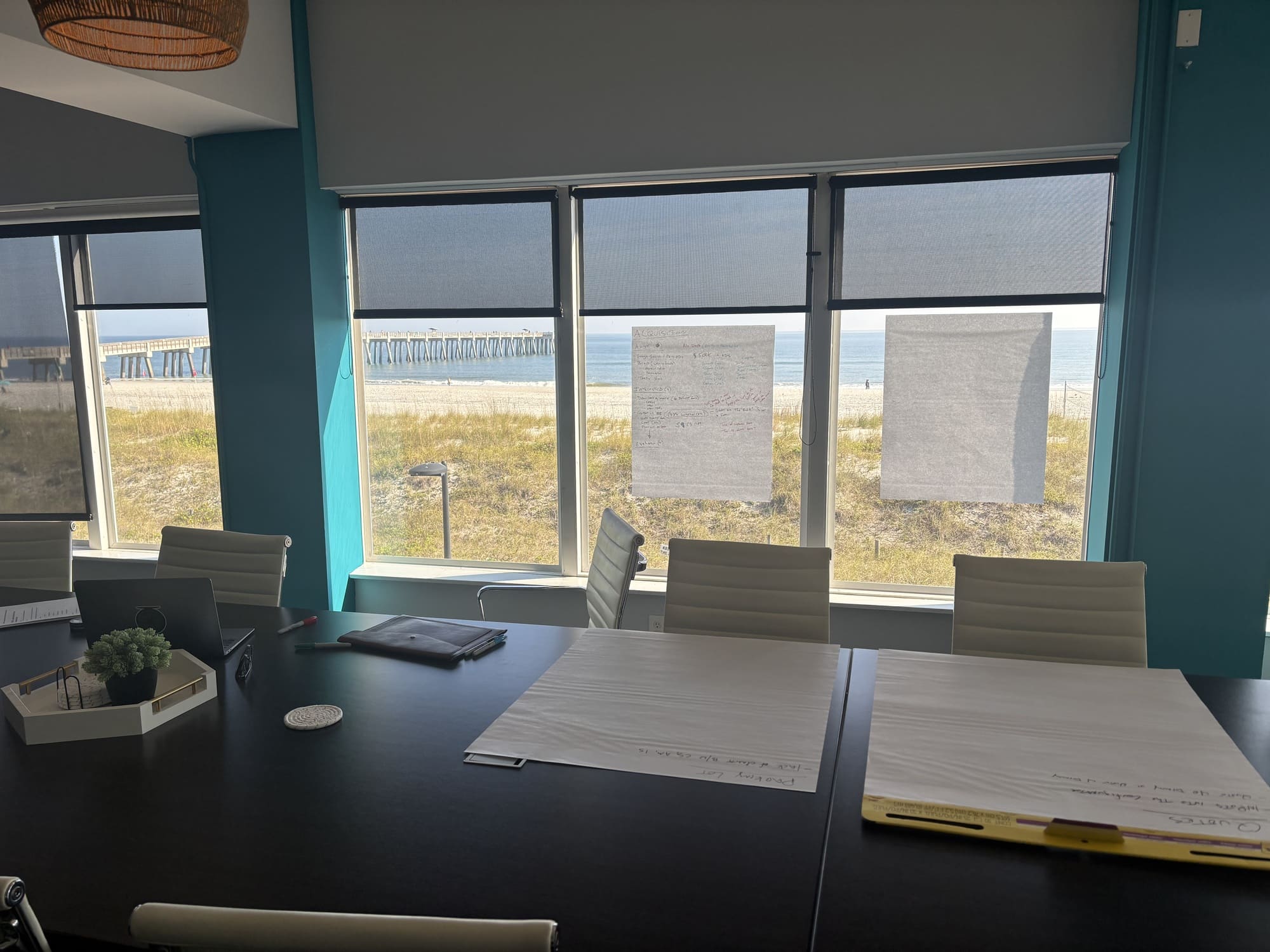
Every room has a parking lot. Most companies never revisit the parked calls.
That date does not exist. There is no month in which killing a product line feels like a good idea.
Which is why the best decision makers in business stopped waiting for one.
Every serious investment
committee already solved this
Investors know deals don’t wait. The diligence is never finished. The model always has one more assumption someone wants to test. There is always a reference call that hasn’t happened, a cohort that hasn’t been cut, a scenario that hasn’t been run.
They decide anyway: deal or no deal.
A decision gets made, an LOI gets drafted. Not because the analysis reached completion, but because the calendar refused to wait for it. Deals must get done. Capital must get deployed.
Nobody calls this reckless. They call it governance.
Boards work the same way. So do budget seasons, earnings publishing, and sales kick-offs. Every one of them is a fixed cadence imposed on an unfixed problem, and the reason they exist is that the problem will never impose a deadline on itself.
The CEO seat is the one place in the entire structure with no such forcing function. Everything on your calendar is about running the business. Nothing on it is about deciding what the business should be.
Unless you decide to be different. If you need evidence that it works, keep reading.
Bill Gates called his Think Week
Twice a year for decades, Bill Gates disappeared.
He left his office, home, and everything noisy for a cabin in the Pacific Northwest. No visitors, family included. Papers gathered in advance and read in a stack. Think Week.
It ran on his calendar, not the company’s latest crisis. It happened in good quarters and bad ones. It happened when the strategy was clear and when it wasn’t. Never skippable or moveable.
Microsoft’s decision to build a browser and take on Netscape came out of one of those weeks in 1995. Jeff Bezos borrowed the format in late 2002 and came back with a restructured company.
Note what Think Week was not. It was not a reaction. Nothing forced it. The internet decision did not appear on Gates’s calendar in 1995 and then demand to be an item for the next executive team meeting.
Think Week was already on the calendar. That’s why the decision had somewhere to land. He was as disciplined about deciding as your personal trainer wishes you were about exercise.
The research says motivation is the part that doesn’t work. You already know that discipline beats motivation.
Exhibit 1
Motivation is the variable that did not move behavior.
Share of participants who exercised at least once a week, by intervention group.
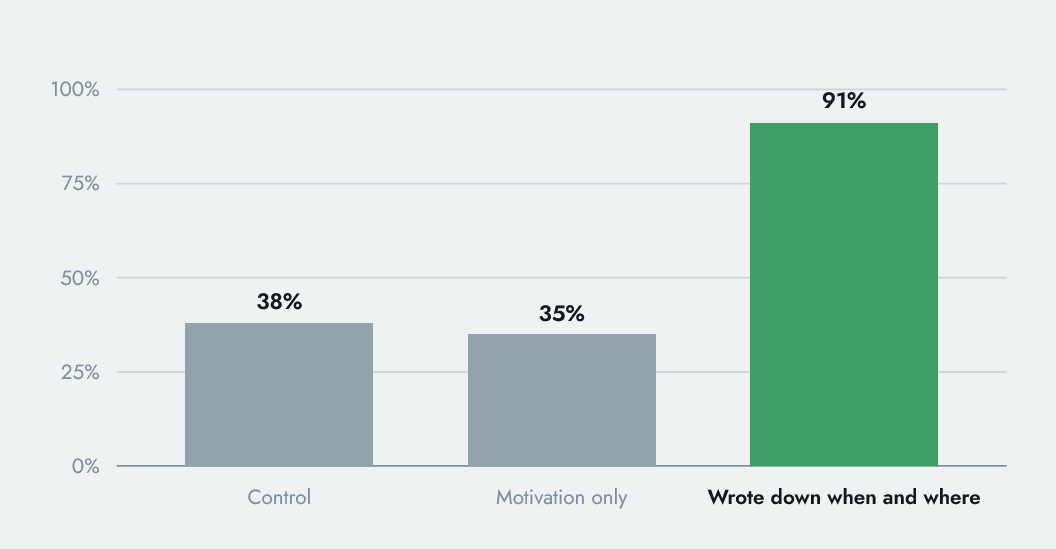
Source: Milne, Orbell & Sheeran, British Journal of Health Psychology, 2002. n = 248.
View data
| Group | Exercised weekly |
|---|---|
| Control | 38% |
| Motivation only | 35% |
| Motivation plus when and where | 91% |
Loads of board meetings end with genuine alignment but no date attached to anything. That’s the trap of motivation. Intentions up, behavior flat.
A commitment without a date is
a wish with better vocabulary.
A structural decision without a date is more expensive than that.
What makes it a Decision Day
and not an Executive Offsite
Decision Days have four rules that separate them from offsites. Break any of them and you have a thoughtful few days that change nothing.
One. Set it before you need it.
The whole point is that it exists on a day when, on the surface, nothing in particular is wrong. If you schedule it because the board is unhappy, you have not built a practice. You have built a crisis response with better scenery.
Once a year is the floor. Twice a year was Gates’s cadence.
Two. Leave the office completely.
Your office is not a neutral decision making environment. It is full of the artifacts of the decision you already made, the people you made it with, and the story you have been telling about why it was right or they were wrong.
Outside environments are not indulgence. It is the only way to look at the business without the business looking back at you.
Three. Bring one question, not an agenda.
An agenda is how you avoid a decision while appearing productive.
The single best question in the record came from Andy Grove in 1985. If the board removed us both and brought in a new CEO tomorrow, what would that person do? Start with that question for your first Decision Days.
It works because it strips your identity off the answer. That is usually all it takes, and it is almost impossible to do without a prompt.
Four. It ends with a decision, not notes.
This is the rule that separates the practice from every offsite you have attended.
You don’t need alignment. There are no next steps. No Gantt chart gets circulated.
You leave with one to three structural calls made, owned, and closed. Nothing left to revisit.
If you leave with a list of things to discuss further, the day failed, and you will carry the same decision into the next one.
Two Decision Day Calendars
Some structural calls do run on a cycle. Annual planning, sales kick-offs, and quarterly board meetings are the obvious ones. Before the budget gets built or meeting agendas are created, Decision Days are useful moments to go away and ask whether the business is aimed at the right thing.
The rest arrive whenever they arrive and then sit.
Which is why the practice needs both. A fixed date on the cycle, for the calls the calendar creates. And a date you can reach on short notice, for the one you have been carrying for a while.
The mistake is assuming you only need the second one. The CEO who waits until the call feels urgent enough to warrant a date has already paid for the year.
Why Decision Days with a Guide Work
Andy Grove, like you and every other CEO, had a building full of people who could see what he could see. Not one of them told him he was delaying a decision at the expense of the team.
They weren’t cowards. They worked for him.
Telling the CEO he is twelve months behind is not a career-enhancing conversation, and everyone in your company knows it. So the person carrying the heaviest decision in the organization is also the only person nobody will be straight with about it.
And they don’t stay quiet forever. They stop telling you, and then they make a decision on you instead.
You won’t like their decision.
You can put the date on the calendar. You can leave the building. You can bring the question.
What you cannot do is be the outsider in your own room.
That part requires someone with no stake in the answer, no reporting line, and no reason to protect you from it.
I run Sea Suite Decision Days out of a house in Jacksonville Beach. Two days. Half strategy, half saltwater. You arrive with nothing to prepare and leave with the one to three structural decisions made.
Each date hosts one CEO, or a management team of up to four. You arrive the evening of day one. The next two days’ structure is set to the tide, not a workshop schedule.
This season on the water
This is low tide season, and the low tide fishing is as good as it gets. The redfish are feisty. The surf is swell dependent. Cold, powerful nor’easters sit on the horizon.
Upcoming dates
12–14 October 2026
14/10/2026
Flood tide, tailing reds
Closed
18–20 November 2026
20/11/2026
Sunrise dead low
Open
20–22 January 2027
22/01/2027
Afternoon dead low
Open
27–29 January 2027
29/01/2027
Outgoing afternoon tide
Open
3–5 February 2027
05/02/2027
Afternoon dead low
Open
17–19 February 2027
19/02/2027
Afternoon dead low
Open
Choosing a date starts the confidential conversation. It does not book anything. If it is a fit, a proposal follows and the date is held.